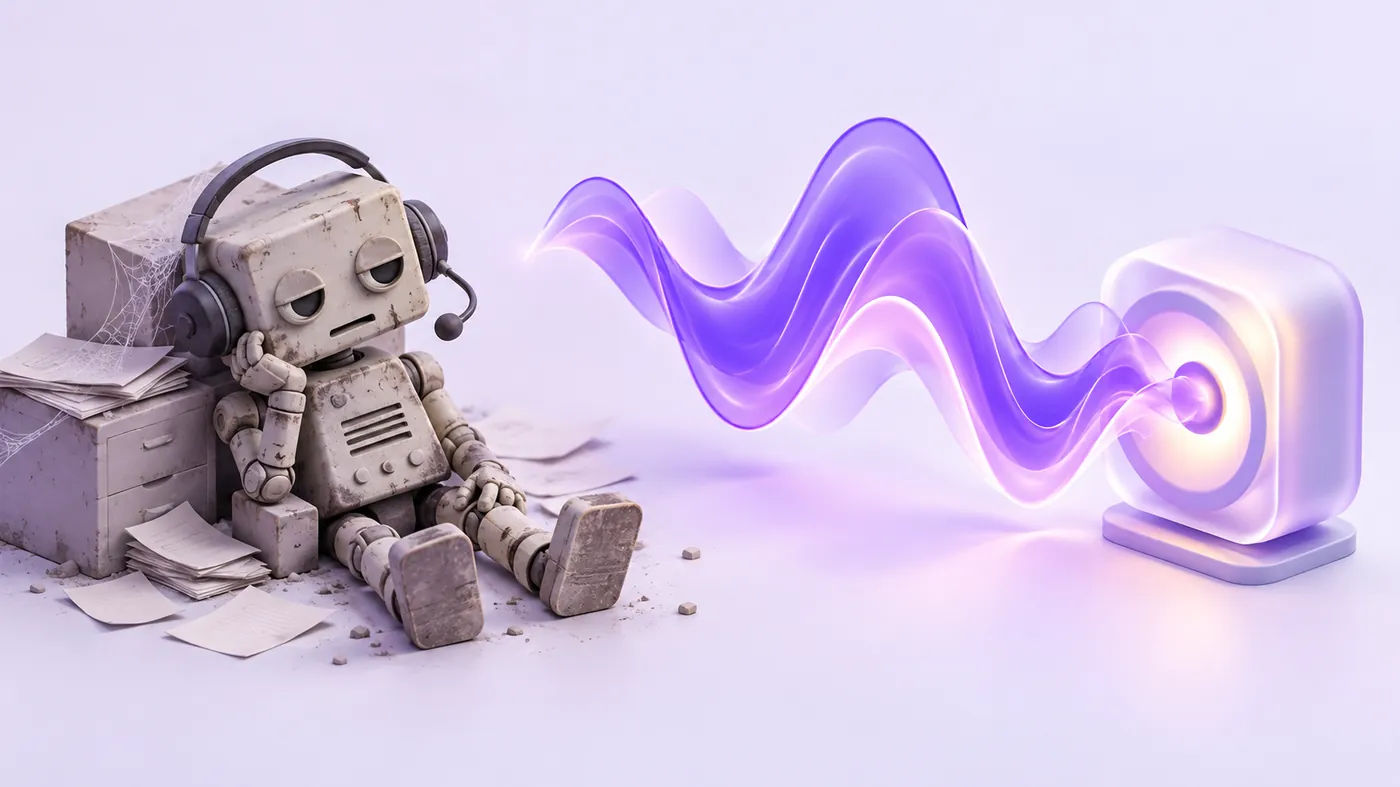
We all hate the robot. Nobody hates a helpful voice.
Press "1 for sales" was never customer service. Today's AI voices sound like a real person, answer in about a second and actually know your venue. Hear the difference for yourself.
Every voice reads the same line (except one speech-to-speech demo)"Hi, thanks for calling Seat Four Vineyards, this is Ava. Good news: September twentieth is still open, and for a hundred and twenty guests the Barrel Room is perfect. Want me to hold a tour for you this Saturday at eleven?"
How far voices have come
From phone tree to front desk in five clicks
Same sentence, five generations of the technology. Press play left to right and listen to the robot turn into a person.
The robotRules, not AI. eSpeak NGFree
Tiny neuralSmall model for cheap devices. PiperFree
Smooth but flatEarly cloud AI voice. OpenAI tts-1Paid
Free and naturalOpen model on a plain CPU. KokoroFree
Human, in real timeExpressive and fast. Eleven v4 TurboPaid
Your call is important to us.Hi, this is Ava. Want a tour?
Take a breath
This is scary, right?
Not the new voice. The old one. It is still at the desk with its headset on, waiting to tell you that your call is important to us.
The robot era is over. A tuned voice agent answers in about a second, and it knows your venue.
It does not say "press 1". It asks what date you have in mind and offers you a tour.
A small joke. Some venue software is named after a number smaller than four, and it is still working out how to count to four. We will wait. We will pull up a seat.
If you are old enough, your first synthesized voice may have been the robot on the airport train in Atlanta in the 1980s. Please stand clear of the doors. We made a tribute, and one for the call center you also remember.
NEXT STOP: CONCOURSE SEAT FOUR
One
Two
Three
Four
Recreations in the style of old machine voices, made on our own computer with eSpeak NG (open source), and a software vocoder for the train. Not the original recordings, and sources disagree on how the real train voice was made, so we do not claim a match. Read about the original at Sunshine Skies.
The sound lab
19 voices. Be honest. Which one would you hang up on?
Free models we ran on our own computer, and paid ones we called through their APIs or through OpenRouter. Nothing edited, nothing cherry-picked, one take each.
eSpeak NG
Open source · rules, not AI
RobotFreeGPL-3.0
The voice of every phone tree you ever yelled at. Instant, tiny, and nobody wants to talk to it.
Piper "Amy", low quality
Open source · tiny neural
RobotFreeRaspberry Pi
A small neural voice made for cheap devices. Better than the robot, still a GPS.
Piper "Lessac", medium
Open source · tiny neural
Getting thereFreeAny CPU
Clear and instant on any computer. Flat delivery: fine for a doorbell, not for a sales call.
OpenAI tts-1
Paid API · early cloud voice
Getting therePaid2.24 s to first sound
OpenAI's first cloud voice. Smooth, but slow to start: 2.24 seconds in our test.
Kokoro-82M
Open source · Apache-2.0
NaturalFreePlain CPU
Only 82 million parameters. Made this 14-second clip in 9 seconds on our server with no graphics card.
Chatterbox
Open source · MIT · Resemble AI
NaturalFreeNeeds a GPU
Warm and expressive. On our CPU it took 161 seconds for 10 seconds of audio, so live calls need a graphics card.
OpenAI tts-1-hd
Paid API
NaturalPaid2.95 s to first sound
The higher-quality version of tts-1. Nicer, and the slowest to start in our test.
OpenAI gpt-4o-mini-tts
Paid API · takes directions
NaturalPaid1.34 s to first sound
You can tell it how to talk. We asked for "a warm, upbeat events coordinator at a vineyard".
Eleven Multilingual v2
Paid API · ElevenLabs
Natural~6¢ / min2.57 s to first sound
ElevenLabs' long-time workhorse. Lovely, but too slow to start for a live call.
Eleven Turbo v2.5
Paid API · ElevenLabs
Natural~3¢ / min0.34 s to first sound
Fast and clean. The older real-time option.
Eleven Flash v2.5
Paid API · ElevenLabs · in GoHighLevel
Natural~3¢ / min0.24 s to first sound
ElevenLabs' cheapest real-time voice, and the one GoHighLevel offers as "V2.5".
Deepgram Aura-2
Paid API · Deepgram · via OpenRouter
Natural~2.3¢ / min0.43 s to first sound
Deepgram's low-cost voice for agents. It streamed, so the first sound arrived in 0.43 seconds. Two transcribers heard the whole line.
Deepgram Flux TTS
Paid API · Deepgram · via OpenRouter
Natural~3.4¢ / min0.31 s to first sound
Built for phone agents: when a caller cuts in, it reports exactly which words were heard. English voices only at launch. Also streamed.
Eleven v3
Paid API · ElevenLabs
Human~6¢ / min0.53 s to first sound
A big jump in emotion and timing over the older ElevenLabs models.
Eleven v4
Paid API · ElevenLabs · #2 ranked
Human~6¢ / min0.57 s to first sound
ElevenLabs' most expressive model, ranked #2 overall. Built for rich, acted delivery.
Eleven v4 Turbo
Paid API · ElevenLabs · #1 ranked
Human~3¢ / min0.23 s to first sound
Close to v4 quality at real-time speed. Our pick for live phone calls.
Eleven v4 with audio tags
Paid API · ElevenLabs
Human~6¢ / min[warmly] [excited]
Same line with performance directions written in. The tags are acted, not read out loud.
Google Gemini 3.8 Flash TTS
Paid API · Google · OpenRouter · #5
Human~1.4¢ / min5.91 s to first sound
Ranked #5 and cheap, but OpenRouter sent the whole clip at once, so the first sound took 5.91 seconds. Left alone it ran "Seat Four" together, so we asked for two words. Fine for recorded greetings, not live calls.
OpenAI gpt-realtime-2.1
Paid API · speech to speech
Humanup to ~10¢ / minDifferent line
One model that hears and talks. This is Ava answering the phone in our demo call, a different line.
Tiers group voices by the technology behind them; your ears are the judge. Free voices were generated on an 8-core server with no graphics card. Most paid voices used each vendor's own API on October 14, 2026, with a stock ElevenLabs voice and OpenAI's "nova" and "marin" voices. Deepgram Aura-2, Deepgram Flux TTS and Google Gemini 3.8 Flash TTS were called through OpenRouter, one account that reaches many vendors, using the stock voices Thalia, Hannah and Kore. Google's listed price for Gemini TTS doubles on January 1, 2027. Clips are volume-matched.
Sounding human is half of it
Answering in time is the other half
A gorgeous voice that pauses three seconds before every answer still feels like a robot. Here is where the time goes on a live call.
~1 sfrom the caller's last word to the agent's first sound
0 s1 s2 s3 s4 s
Ears: notice the caller stoppedBrain: first words of the answerVoice: first sound out
We timed each voice: how long until the first sound comes back
Eleven v4 Turbo0.23 s
Eleven Flash v2.50.24 s
Deepgram Flux TTS0.31 s
Eleven Turbo v2.50.34 s
Deepgram Aura-20.43 s
Eleven v30.53 s
Eleven v40.57 s
OpenAI gpt-4o-mini-tts1.34 s
OpenAI tts-12.24 s
Eleven Multilingual v22.57 s
OpenAI tts-1-hd2.95 s
Google Gemini 3.8 Flash TTS5.91 s
One request each from our server in North America on October 14, 2026, network included, using each vendor's streaming endpoint where it has one. Deepgram's two voices went through OpenRouter and streamed; Google's Gemini voice came back as one piece, so its first sound is the whole clip (seven requests ranged from 4.7 to 6.2 seconds). Your numbers will differ. Free voices on a plain CPU: Kokoro made 14 seconds of speech in 9 seconds; Chatterbox needed 161 seconds for 10 seconds, so it needs a graphics card for live calls.
Barge-in
The caller interrupts, the agent stops talking and listens. Good agents also remember exactly which words the caller heard before they cut in.
Turn detection
Knowing "they paused to think" from "they are done talking". Get it wrong and the agent interrupts, or waits forever.
Speech to speech
Newer models hear and talk in one step instead of three. Simpler to build; often pricier, and fewer voices to choose from.
Human turn gap: about 0.2 seconds on average across ten languages (Stivers and colleagues, PNAS, 2009). AI agent stages from published independent medians: turn detection about 0.2 to 0.26 s, small-model first token about 0.54 to 0.64 s, streaming voice about 0.2 to 0.33 s.
Under the hood
How a voice agent actually works
A phone call is a stream, not a file. Step through what happens between "Hello?" and "Want me to hold a tour?"
1
Step 1 of 8
A call comes inThe caller dials your number. The phone line passes the live audio to your agent: a Twilio Media Streams WebSocket, a SIP trunk, or a 3CX Programmable Extension that behaves like an extension on your phone system.
Is anyone talking? Are they done?A small voice activity model spots speech, and turn detection decides whether the caller has finished or is only pausing to think. Get it wrong and the agent talks over people, or waits forever.
Speech becomes textStreaming speech to text writes the words as they are spoken. Phone audio is 8 kHz, so pick an engine that copes with it.
The brain decides what to sayA language model reads the words and the rules you gave it. It searches your knowledge base first, and it can use tools, such as the calendar and your CRM, to check a date or log the lead.
Text becomes speechA streaming voice starts speaking the first words while the rest of the reply is still being written. This is the step we timed in the sound lab.
The answer goes back to the callerThe audio returns down the same connection in the phone line's format. On a tuned build the whole trip, from the caller's last word to the agent's first sound, takes about a second.
Barge-in: the caller cuts inWhen the caller talks over the agent, the pipeline cancels the reply, clears the voice buffer and flushes audio that has not played yet. On Twilio the app also sends a clear message so the phone line drops what it had queued.
Hand off to a humanWhen the caller asks for a person, the agent transfers the call. Over a SIP trunk that is a SIP REFER, and a 3CX Programmable Extension can transfer natively.
You do not build this plumbing yourself. Open-source frameworks run the whole pipeline: Pipecat (BSD-2-Clause) and LiveKit Agents (Apache-2.0). Hosted products such as ElevenLabs Agents and GoHighLevel Voice AI run the same pipeline for you.
The brain and what it knows
A pretty voice that knows nothing is still a robot
The voice is the outfit. The knowledge base is the training. Load the questions your team answers every week, plus your rules, and the agent stops guessing and starts helping.
0real questions and answers. That is the magic number.
No knowledge base
With your knowledge base
01Write down every questionParking, minimums, outside food, ages, rain plans, AV, load-in. Your staff already know the 150. Ask them.
02Add your rulesNever quote prices. Never promise a date. Always offer the tour. Hand off angry callers to a human.
03Let it look things upThe agent searches your answers before it speaks, so it repeats your words instead of inventing its own.
04Read the transcriptsEvery call is written down. Each new question becomes answer 151, 152, 153. It gets smarter every week.
Two more pieces
Every call written down. One agent you can try today.
A transcript of every conversation, and a free way to meet an AI agent before you build one.
Every call, written down
After the call, a transcription model turns the recording into text with speaker labels and a timestamp on every word. That is your call log, your coaching material and the list of questions your knowledge base is still missing.
AvaHi, thanks for calling Seat Four Vineyards, this is Ava.
CallerHi! Is September twentieth still open?
AvaGood news: it is. How many guests are you planning for?
Format illustration with made-up lines.
ElevenLabs Scribe v2 lists at $0.22 per hour of audio, about 0.4 of a cent a minute. A hundred hours of calls is $22.
Up to 32 speakers, word-level timestamps and 90+ languages. Two-channel recordings can keep the caller and the agent on separate labels.
Also on OpenRouter as elevenlabs/scribe-v2, at half price until October 19, 2026. We used it to check the clips on this page.
A Scribe v2 Medical version exists for clinical recordings. A venue does not need it.
ElevenLabs does not publish accuracy on 8 kHz phone-line audio, and we have not tested it. Try it on a few of your own recordings first.
Try one yourself
ElevenLabs publishes ready-made agent templates you can copy into your own account and edit: Customer Support, Front Desk Receptionist, Inbound Lead Qualifier, Appointment Setter, Hospitality Concierge and more.
The Customer Support template uses the Veda Sky voice and gemini-3.5-flash as its brain.
Copying a template is free on the free plan. That plan is for non-commercial use, so treat it as a test drive, not a phone system.
We do not embed a live agent here. A public agent bills whoever owns it by the minute (ElevenLabs lists $0.08 a minute, plus the brain), and the embed needs third-party scripts.
Pay a vendor directly through its API, use what GoHighLevel has built in, or run open models yourself. Here is who is who.
Paid voices
Voice
Best at
Direct API, per spoken minute
Speed (vendor claim)
Built into GoHighLevel?
Eleven v4 TurboElevenLabs · #1 on Artificial Analysis
Human-sounding live calls, 90+ languages, audio tags
~3¢
~0.15 s to first speech
No
Eleven v4ElevenLabs · #2
The most expressive delivery, multi-speaker dialogue
~6¢
use Turbo for live calls
No
Eleven Flash v2.5ElevenLabs
Cheapest fast ElevenLabs voice, 32 languages
~3¢
~75 ms
Yes, "V2.5", +3.5¢
Sonic-3.6Cartesia · #4
Speed, numbers and codes read right, 44 languages
~2.8 to 3.8¢
under 90 ms
"Cartesia", +1.5¢
Flux TTSDeepgram
Built for agents: knows exactly what the caller heard when interrupted
~3.4¢
as low as 80 ms
No
Aura-2Deepgram
Clear, low cost
~2.3¢
not stated
No
gpt-realtime-2.1OpenAI · speech to speech
One model hears, thinks and talks
up to ~10¢ (our math)
not stated
Yes, 20¢ all-in
Gemini LiveGoogle · speech to speech
Audio in and out, low token prices
~2.3¢ audio (our math)
not stated
Gemini 3.1, 10¢ all-in
Voice prices assume about 750 characters of speech per minute. GoHighLevel adds its $0.045 per minute Voice AI engine fee before the voice, plus phone charges; its speech-to-speech prices are all-in. Rankings: Artificial Analysis provider voice leaderboard, October 14, 2026. Speeds are each vendor's own figures and leave out the network.
Free and open voices
Voice
Licence
Runs on
Good to know
Kokoro-82M
Apache-2.0
Any CPU
Top-ranked open voice that allows commercial use. Faster than real time on a plain CPU in our test.
ChatterboxResemble AI
MIT
GPU (Nano works on CPU)
Warm and expressive. Its newer Turbo model targets voice agents. Audio carries a built-in watermark.
Orpheus 3BCanopy Labs
Apache-2.0
GPU
Very human; about 0.2 s streaming by its makers' account. Built on Llama, so check those terms too.
Qwen3-TTSAlibaba
Apache-2.0
GPU
0.6B and 1.7B sizes, 10 languages, 3-second voice cloning.
Dia 1.6BNari Labs
Apache-2.0
GPU, ~4.4 GB
Two-speaker dialogue with laughs and sighs.
Sesame CSM-1B
Apache-2.0
GPU
Conversation-aware speech. The famous demo uses a model they did not release.
Piper
GPL-3.0
Raspberry Pi
Tiny and instant. Fine for announcements, flat for sales.
eSpeak NG
GPL-3.0
Anything
The robot. Included for science.
F5-TTS · XTTS-v2
Non-commercial
GPU
Great demos, but the weights are not licensed for business use. Skip them for a venue.
Licences from each project's model card and repository, October 14, 2026. "Free" means no licence fee; you still need the hardware to run it.
Brains (the model that decides what to say)
Paid, fast and small
For a phone call you want a small model that starts answering in about half a second. Big "genius" models are slower and cost more, and your knowledge base does the heavy lifting anyway.
Model
Per 1M tokens in / out
GPT-5 nanoOpenAI
$0.05 / $0.40
Claude Haiku 5.5Anthropic
$0.10 / $0.50
Gemini 3.1 Flash-LiteGoogle
$0.25 / $1.50
GPT-5 miniOpenAI, also in GoHighLevel
$0.25 / $2.00
DeepSeek FlashDeepSeek
$0.30 / $1.20
Open, free to run
Download once with Ollama and run them on your own machine. No per-call fees, and the conversation never leaves your building.
Model family
Licence
Qwen 3.5 / 3.6Alibaba, small to large
Apache-2.0
Gemma 4Google
Apache-2.0
gpt-oss 20BOpenAI open weights
Apache-2.0
Ministral 3Mistral, 3B to 14B
Apache-2.0
Great for email and chat today. For live calls, local brains need a solid graphics card to keep up.
Prices from each vendor's pricing page, October 14, 2026. Running costs for every piece are on What it really costs.
Getting an AI on your phones
The easy way, or your own way
Both work. One rents you a finished agent. The other hands you the keys. We are building Seat Four to make the second one feel like the first.
Open Voice AI in GoHighLevelCreate an agent and give it a name and a greeting.
Pick a voiceOpenAI, Cartesia, ElevenLabs V2.5 or V3, or a speech-to-speech model from Google or OpenAI.
Add a knowledge baseOne per agent: paste your FAQs and policies.
Attach a phone numberBuy one in GoHighLevel or connect your own Twilio account.
Go liveCalls, transcripts and bookings land in your CRM.
~7 to 9¢ / min
Engine $0.045 + voice + phone, or $97 a month for unlimited plus phone charges. On top of a GoHighLevel plan from $97 a month.
Live in an afternoon, no servers
Support and a polished app
Per-minute markup on every call
Only the voices they offer, no Eleven v4
Your agent lives in their building
Already on GoHighLevel? Seat Four's optional connector keeps working with it.
Get your own Twilio numberBring calls in over a SIP trunk for about a third of a cent a minute.
Rent a small serverThe same $5 to $15 VPS that runs Seat Four.
Run an open-source agent frameworkPipecat or LiveKit Agents connects the call to the AI parts.
Choose ears, brain and voiceFor example Deepgram for listening, a small fast model for thinking and Eleven v4 Turbo for talking. Swap any piece any time.
Load your 150+ questionsYour knowledge base and rules, in plain text you own.
Test with real callsCall it 50 times, read the transcripts, fix the answers.
Turn it onCalls, transcripts and tours land in Seat Four.
~2 to 5¢ / min
Phone line, ears, brain and voice, each paid directly at list price. Software: $0.00.
Cheapest per minute, by a lot
Any voice on the market, including the best
You own the agent, the data and the recordings
More setup, and you keep it running
We are writing the step-by-step guides as we build, and a one-command install ships with the public release.
Need a hand? We are exploring it
Help if you want it. Strings never.
Not everyone wants to wire up their own AI, and that is fine. We are looking at a very low-cost setup and management service, run by volunteers from the community, for venues that would rather not do it alone. Before we build any of it, here is the deal in writing.
We never own your data
Your clients, calls and recordings stay in your database, in your name. Not ours. Not anyone's.
We never host it on our servers
Everything runs on a server and accounts you control. We help you set them up; we never hold them.
We never tie you to a contract
No annual terms. No auto-renew trap. No cancellation fee. Stop whenever you want.
We never lock you in
Every setup is documented in plain language so you, your nephew or any IT person can take it over.
I have worked for myself for 23 years. I don't let anyone else control my destiny, and nobody should control yours.
The venue owner who started Seat Four
Our goal is to put ourselves out of a job. We want you to have the skills to run this yourself, or to walk away from any service, ours included, the day it stops serving you. Free of depending on:
big software companiesmiddlemenannual contractsthe governmentany one personus
Raise your hand
Know your way around a server? Volunteer to help venues set up their own AI and get them through the first week. We will share everything we learn.
Want help at your venue? Tell us. We are figuring out how to make it cost very little, and you will hear first.
The phone line streams the caller's audio to your agent over a WebSocket or a SIP connection. The agent works out when the caller has stopped talking, turns the speech into text, lets a language model decide what to say using your knowledge base and tools such as the calendar, and speaks the answer with a streaming voice. If the caller interrupts, it stops mid-sentence, and it can transfer the call to a person.
What is the best AI voice for phone calls in 2026?
On the Artificial Analysis voice leaderboard in October 2026, ElevenLabs Eleven v4 Turbo ranks first and Eleven v4 second, with Cartesia Sonic-3.6 fourth. For live phone calls you want a fast streaming voice: in our own test Eleven v4 Turbo and Eleven Flash v2.5 returned their first audio in about a quarter of a second.
What is the best free AI voice?
Kokoro-82M (Apache-2.0) is the top-ranked open voice that allows commercial use on the Artificial Analysis leaderboard, and it runs on an ordinary CPU. Chatterbox (MIT), Orpheus (Apache-2.0) and Qwen3-TTS (Apache-2.0) sound very natural too but need a graphics card for live calls. Watch the licence: F5-TTS weights and XTTS-v2 are non-commercial.
How fast does an AI phone agent need to respond?
People leave about 0.2 seconds between turns in conversation. A well-tuned AI agent built from speech-to-text, a language model and a streaming voice answers in roughly 0.9 to 1.2 seconds, which callers accept. Slow parts push it to several seconds of dead air.
Why does an AI receptionist need a knowledge base?
A natural voice that does not know your answers still makes things up or sends callers to voicemail. Loading 150 or more real questions and answers about your venue, plus rules like never quoting prices, lets the agent answer correctly and stay helpful.
Will Seat Four host my AI agent or my data?
No. We are exploring a very low-cost, volunteer-run setup and management service, but we will never own your data, never host it on our infrastructure, never tie you to a contract and never lock you in. Everything runs on your own server and accounts, and we document it so you can run it yourself or move away at any time.
Pull up a seat
Fire the robot. Keep the keys.
Join the beta list to put a helpful voice on your phones with software you own.
Audio samples were generated by us on October 14, 2026 with each model's standard settings and are illustrations, not endorsements. Seat Four is not affiliated with, sponsored by or paid by any company named on this page.